 Help With Debt That Fits Your Budget Help With Debt That Fits Your Budget
Getting help with debt should not feel like another bill you cannot pay.
When money is already tight, even a small new cost can feel impossible to handle.
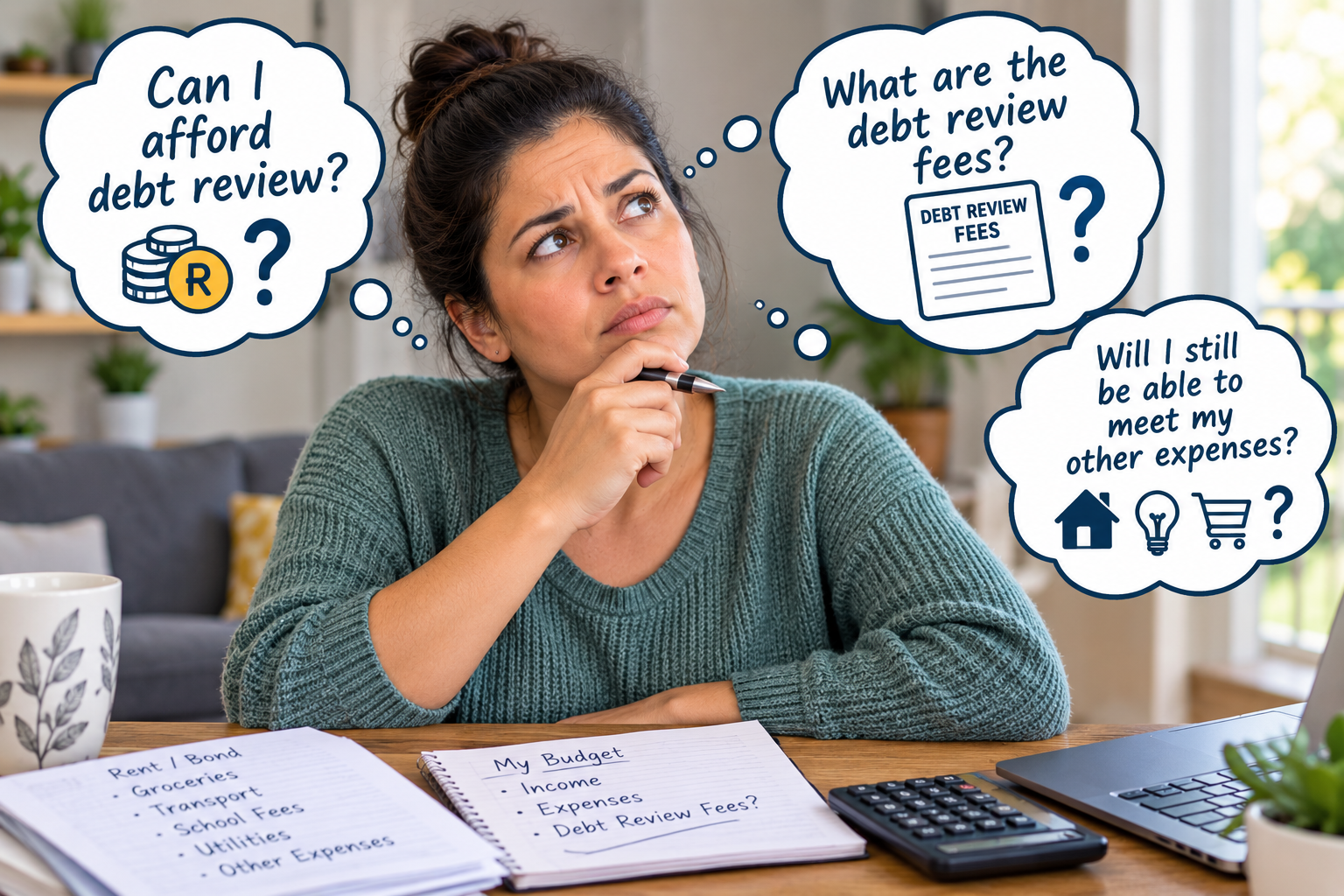
That’s why many consumers delay speaking to a debt counsellor because they assume professional help will require a large cash payment.
Others have heard that debt review is free and are surprised when fees appear.
The reality is somewhere between the two. Debt review has costs, but the larger fees are structured into the monthly payment the consumer can realistically afford. Let’s discuss the fees.
How Debt Review Works
When you apply for help a debt counsellor will work out what you need to cover your monthly costs and whatever is left. That figure is then split among the people you owe money to. The debt counsellor and the courts will help make that arrangement binding on the credit providers and as long as you stick to the repayment plan you will eventually get out of debt. It takes time but is manageable.
The fees for the process are built into these monthly affordable payments.
Is Debt Review Free
No. Debt review is a formal process under the National Credit Act. A debt counsellor assesses your household budget and credit agreements, decides whether you appears to be overindebted, prepares a repayment proposal, communicates with credit providers and arranges for the matter to go to court or the National Consumer Tribunal where appropriate. The debt counsellor will then continue assisting while the repayment plan is running.
That work takes time and professional skill. It also involves legal work and, in many cases, a Payment Distribution Agent that receives the consumer’s single monthly payment and distributes it to the correct credit providers.
An initial conversation will be free. Many debt counsellors are happy to look at a basic budget, discuss warning signs and explain possible options without charging for that first chat. A chat is not formally starting the process. That’s taking things to the next level and involves signing forms etc. If you do apply, then some fees will start to apply.
The NCR guideline provides for a R50 application fee and an administration fee of up to R300. So, these initial fees are tiny.
Some Bigger Fees
After the debt counsellor has worked out what you can realistically afford to pay towards debt each month, they work out a plan and some fees will be included in that plan and shared with credit providers.
The restructuring fee pays for the detailed work needed to fully assess the consumer and prepare the very complex and detailed proposed repayment plan. Under the commonly used NCR fee guideline, this fee is linked to the first restructured monthly payment. It is capped at R8 000 for one consumer and R9 000 for a joint application.
A joint application is common where spouses are married in community of property because both spouses must take part. Couples in other marital arrangements may also apply together when appropriate. The debt counsellor will explain how the cap applies to your particular application.
Legal fees are separate. The amount depends on the attorney and the work required. The fee will be disclosed and agreed before the legal work even begins. Legal fees are commonly recovered from your second restructured payment, which avoids a large separate legal bill at the start. It is built in.
Aftercare fees cover the ongoing work performed once the repayment plan is running. This can include monitoring the matter, dealing with queries, following up on balances and assisting with paid up letters and clearance when the legal requirements are met. The guideline provides for 5% of the monthly amount, capped at R450.
A small monthly PDA fee may also apply if the consumer chooses to use a Payment Distribution Agent. This fee is separate from the debt counsellor’s aftercare fee and depends on the amount being distributed. The fees are ridiculously small compared to other banking type fees.
Each month during the process the consumer will receive a statement showing where all the money went.
How The Monthly Payment Works
Suppose a consumer’s contractual debt repayments add up to R5 000 a month, but their budget shows that only R2 500 is realistically available. This will become the debt review repayment proposal amount that goes to court.
In the first month, all of that payment may be used for the restructuring fee. In the second month, some or all may be used for agreed legal costs. From the following months, the payment is mainly distributed to credit providers (after the small aftercare and PDA fees).
Now let’s look at a bigger repayment amount. Consider someone who can realistically afford R25 000 a month. Because the restructuring fee is capped, only part of the first payment may be used for that fee and the balance can be distributed to credit providers. The same principle can apply when legal costs are recovered from the second payment.
These examples explain the general flow, but every case is different. A consumer should never have to guess. The written fee disclosure and repayment proposal should show what will happen in the early months and what will be distributed after that.
What To Check Before Applying
First, confirm that the debt counsellor is registered with the National Credit Regulator. Ask for their NCR registration number and check it against the NCR register.
Second, after discussing your unique situation ask for a full written fee schedule. It should show the application fee, administration fee, restructuring fee, legal fee, aftercare fee, PDA fee and whether VAT is included or added. Feel free to ask which payment covers each fee and how much is expected to reach credit providers in the first few months.
Third, read the application before signing. Make sure you understand when the formal debt review process begins, what information will be sent to credit providers and credit bureaus, and what your monthly responsibilities will be.
Finally, be cautious of anyone who asks for a large cash payment before doing an assessment, guarantees a new loan or promises an instant removal from debt review. Professional help should come with clear documents, realistic explanations and no pressure to sign immediately.
Help That Fits Your Budget
Debt review is not free, but the costs are all built into the process and are almost insignificant compared to the benefits.
Any fees that do apply are built into the regular monthly repayment amount that you can realistically handle. Not above and beyond. And the credit providers will also know what these fees are. The fees are pretty standard across the industry. The NCR even has a guideline on what most debt counsellors charge.
But most important, don’t let fear of paying a few fees stop you from having a first conversation with a debt counsellor about your debt.
And when you do chat to them feel free to ask questions, request the figures in writing and choose a registered debt counsellor who explains both the cost and the value of the work being done.
Debt review fees are minimal but the benefits of the process and it’s impact on your day to day life are amazing. |
 Help With Debt That Fits Your Budget

